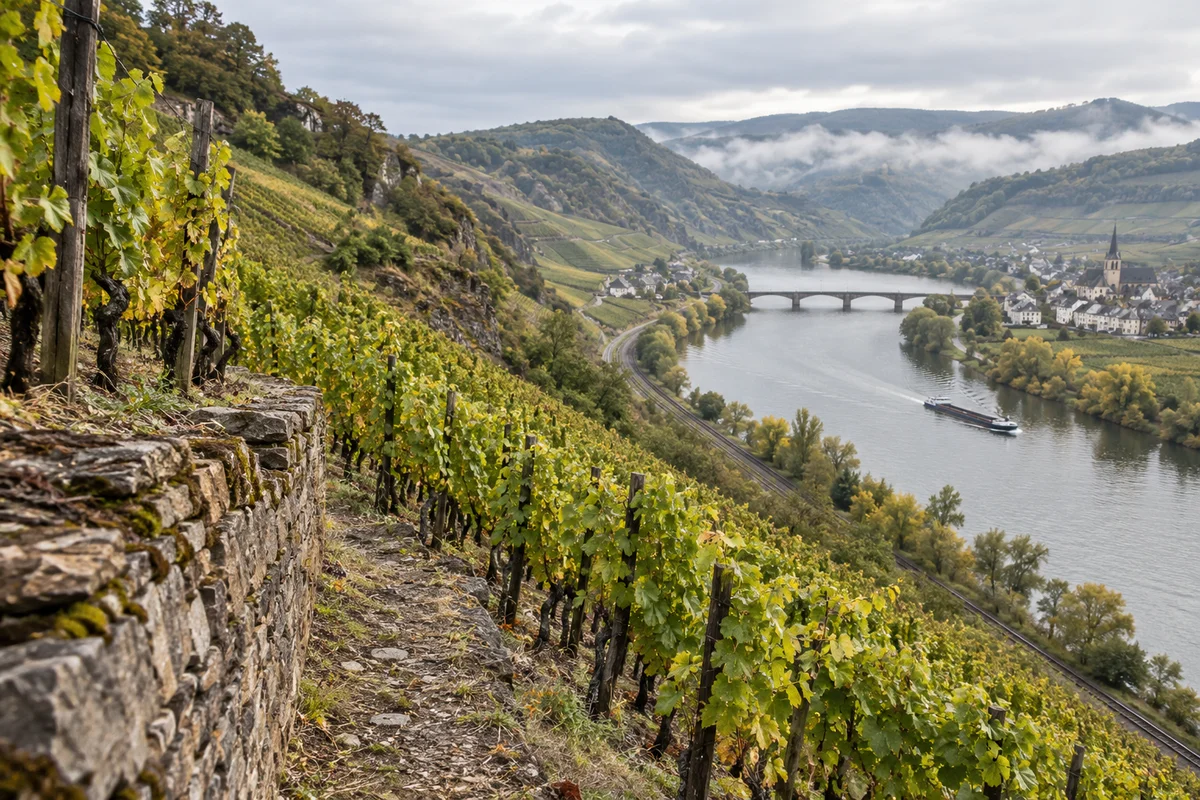
Mosel · Documentary photograph
Germany

Mosel

Steep slopes and luminous Riesling, from dry to delicately sweet.

Documentary photograph · Peulle · Source · CC0 · Resized and converted to WebP; no retouching.

Signature

Mosel

Precise acidity, fresh fruit and lightness mark the wines of this river landscape.

Terroirs, appellations and label clues

Mosel also includes Saar and Ruwer. Trocken indicates dry wine; a Prädikat such as Kabinett or Spätlese describes grape ripeness, not final sweetness alone. Check the sugar indication or wine sheet.

To get started

Taste two Rieslings with different sweetness levels and notice how acidity supports balance in each.

Key grapes

Riesling: Citrus, precision and vivid acidity. Do not infer sweetness from the grape name alone: check the style and taste the balance between any sugar and acidity.

Compare regions

Compare regions in the same country too: the same grape can produce different wines as climate, site and producer choices change.

Style descriptions are guides, not rules: vintage, vineyard, blending and maturation change the result.

Two routes to understand styles

First route

Mosel Riesling trocken

Second route

Mosel Riesling Kabinett

Check whether the Kabinett bottle is dry or sweet: Prädikat alone does not answer this. Compare acidity-sweetness balance at similar temperatures.

Practical guides → · Comparison tools →

Frequently asked questions

Which grapes can I explore in this region?
How can I start a comparison?

Taste two Rieslings with different sweetness levels and notice how acidity supports balance in each.

About the images

Illustrative images are AI-generated for FRANCE VINS. Landscapes evoke wine regions; grape images illustrate grapes without identifying a variety.

Pinpointing places and styles

Mosel · Saar · Ruwer

The Mosel area also includes vineyards on the Saar and Ruwer. Its legal division has six Bereiche: Burg Cochem, Bernkastel, Saar, Ruwer, Obermosel and Moseltor. A Saar wine can therefore carry Mosel origin without its grapes having grown beside the Mosel river itself.

Schiefer / Dolomit

Slate shapes many Mittelmosel and Ruwer slopes. In the south of the area, near the Germany–France–Luxembourg tripoint, dolomite formations provide a different geological setting. “Mosel = slate” is therefore shorthand: identify village and vineyard before interpreting a soil term.

Regional references : Moselwein · Teilregionen ↗ · Moselwein · Ruwer ↗

Producers to explore in the guide

FRANCE VINS · ATLAS

Wine landmark map · Mosel

Choose a country, filter by grape and select a region on the map.

Select a landmark to display its profile. Use the buttons to zoom and pan.

1 regions

Mosel

Bernkastel-Kues · Germany

Steep slopes and luminous Riesling, from dry to delicately sweet. Precise acidity, fresh fruit and lightness mark the wines of this river landscape.

Explore the region →

Associated grapes

Landmark source · Bernkastel-Kues

Regions to explore

Points locate urban or island landmarks, not appellation boundaries. The map covers the profiles published on this website.

Geographical basemap : Natural Earth · Public domain.

Region and grape list
Reading the label

Trocken, halbtrocken, feinherb: three different indications

Trocken means dry, with a limit of 4 g/L or 9 g/L when the acidity condition is met. Halbtrocken means medium dry: 12 g/L, or 18 g/L subject to acidity. Feinherb has no legally defined threshold. Kabinett and Spätlese indicate grape ripeness at harvest, not directly the sugar in the finished wine: look separately for the taste description and the specific technical sheet.

References : Deutsches Weininstitut · Geschmack · Deutsches Weininstitut · Prädikate

Use the sweetness decoder → · Understanding wine sweetness →